
Photo: Dylan Ribott
By Daniel Susann | @dsus_sus
To start the 2026 men’s soccer season, we have an eligibility crisis on our hands.
It all started on July 31 as a federal district court judge in Colorado issued a classwide injunction granting eligibility for graduating seniors excluded from the new “5-in-5” framework.
Since then, players and coaches have weathered a confusing end of the summer with an end only approaching on the horizon. By the conclusion of this saga, we might be halfway through the men’s and women’s college soccer seasons. And with the NCAA remaining firm in their doctrine, it will come down to the say of an appellate judge.
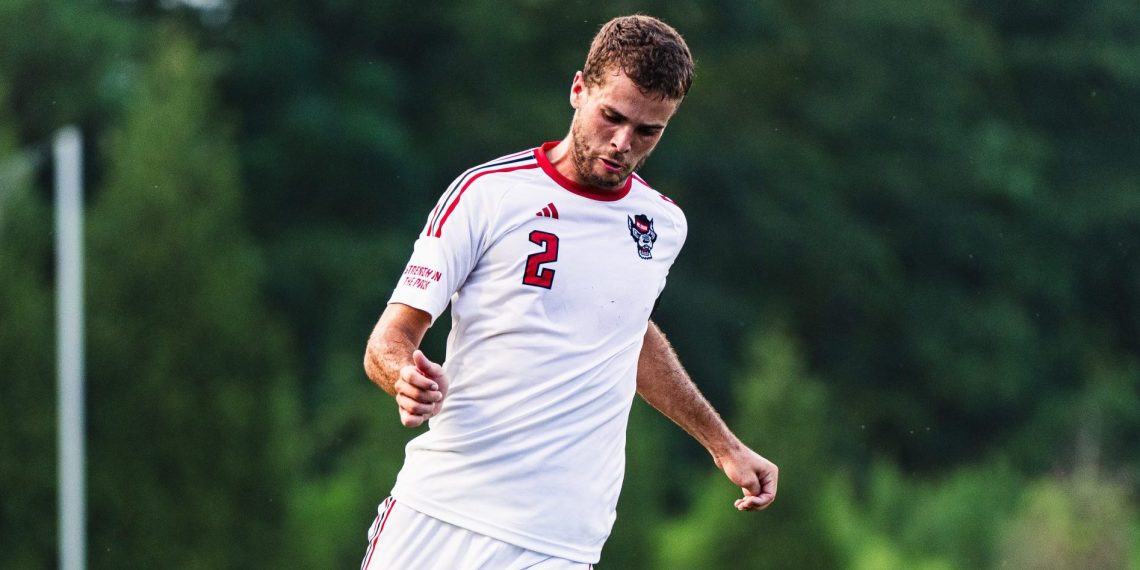
This story can most easily be told in a timeline format through the anecdote of a single player. Say, NC State fifth year midfielder Drew Lovelace. Coming into the No. 2-ranked Wolfpack’s season following a national championship berth in 2025, Lovelace was not in the picture; at least to the public eye. But he was around, training with the NC State squad, as the coaching staff had heard whisperings that he might get another shot to compete.
Lovelace left his adult job as a director at Wake FC, a local youth soccer league that he grew up playing in.
“I got the call from [Head Coach Marc Hubbard], and everything happened pretty quickly the past two weeks,” Lovelace said after the Wolfpack’s season opener versus Coastal Carolina. “And he was just like, ‘come out to training, see what happens,’ and then stuff ended up getting passed and now it’s kind of the real deal.”
Lovelace played 55 minutes of the Aug. 20 season opener, with the match ending in a scoreless draw.
A day later, he was ineligible.
On Aug. 21, the Tenth Circuit of the Colorado Court of Appeals granted a stay on the injunction which provided fifth years an opportunity to return — a small win for the NCAA. For now, that action prevents many of the fifth years from continuing to compete.
There is still a chance that the classwide waiver could be restored if the Appellate Court sides with the plaintiffs and reaffirm the district court judge in Wisne v. NCAA, the case dictating the fate of these athletes. But the briefings are set to take place over the next week and a half till Sept. 11, and oral arguments are not even scheduled. It could be until the end of September or longer before we get a final ruling — more than halfway through the college soccer season.
Adding to the chaos, judges at the state level have been granting temporary restraining orders (TROs) and injunctions to allow football and basketball athletes to play, forcing the NCAA to fight on multiple fronts, and often on away turf in the jurisdiction where the university is, such as in Wooden v. NCAA where an Arkansas football player was granted a TRO in the Washington County, Arkansas, Circuit Court.
As it stands right now, there is very little stability in the fight for eligibility as standards are fragmented between state jurisdictions, and the playing field may not be leveled for some time.
Lovelace did not play in the Wolfpack’s three subsequent matches, as the red-and-white squeaked by Queens 2-1, losing to FIU 1-2, and then drawing FAU 3-3.